
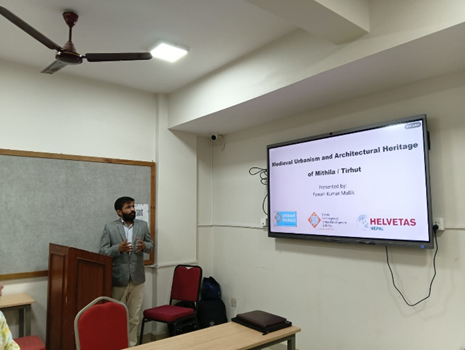
The fifth session of the Urban Dabali series titled “Medieval Urbanism and Architectural Heritage of Mithila/Tirhut”was held on 29 May 2026 at Universal Engineering and Science College, Chakupat, Lalitpur. Jointly organized by the Centre for Integrated Urban Development (CIUD) and Helvetas Nepal, the session focused on the historical, architectural, and cultural significance of the Mithila/Tirhut region and the need for greater recognition and conservation of its heritage.
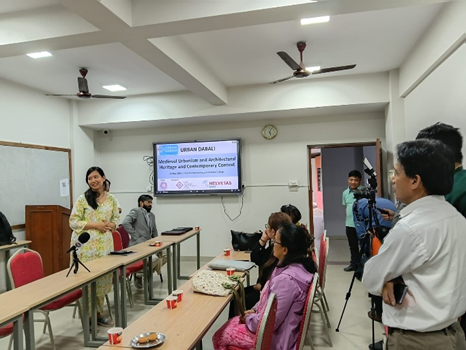
The program began with opening remarks by Ms. Rija Joshi, Executive Director of CIUD, who emphasized the importance of understanding and preserving Nepal’s diverse cultural heritage. Mr. Sudarshan Rajbhandari, Program Director of CIUD, introduced the Urban Dabali platform and explained its role in creating dialogue on urban development, heritage, planning, and related issues. The participants of the session included researchers, heritage professionals, students, urban practitioners, and cultural enthusiasts.
The main presentation was delivered by Mr. Pawan Kumar Mallik, who discussed the medieval urbanism, fortified settlements, and architectural heritage of Tirhut. Drawing on archaeological, historical, and cultural evidence, he highlighted the region’s importance as a center of art, architecture, trade, and cultural exchange. Particular attention was given to Simraungarh, a significant medieval urban settlement in the eastern Terai where evidence like fortifications, settlement remains, ponds, temples, and other archaeological structures demonstrated the area’s historical importance. The presentation also explored the contributions of the Karnata rulers, the cultural significance of Mithila and Janakpur, and historical connections between present-day Nepal and India.
The presentation was followed by a panel discussion involving Prof. Dr. Madan Kumar Rimal of Tribhuvan University, Mr. Prakash Darnal, Senior Archaeologist, and Mr. Rajesh Pariyar from the Department of Archaeology. The panel emphasized the need for stronger research, documentation, and conservation of historical settlements, monuments, and cultural landscapes. The major challenges identified included limited documentation, inadequate public awareness, urban expansion, and insufficient institutional attention to important heritage sites. The panelists stressed collaboration among government agencies, academic institutions, local governments, heritage professionals, and communities.
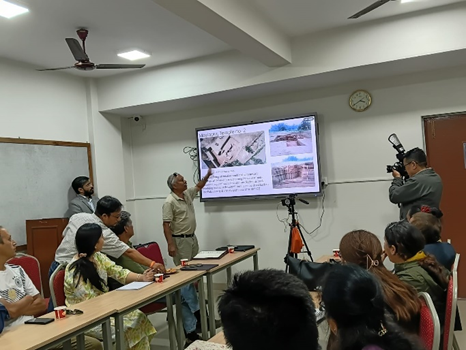
During the open-floor discussion, participants raised questions about Simraungarh, medieval settlement patterns, archaeological research, architectural characteristics of Mithila heritage, and the cultural importance of Janakpur and other heritage centers. They also expressed their concerns about the limited availability of museums and interpretation centers for archaeological discoveries from Madhesh. Participants also emphasized the importance of public awareness, local ownership, educational engagement, and community participation in heritage conservation.
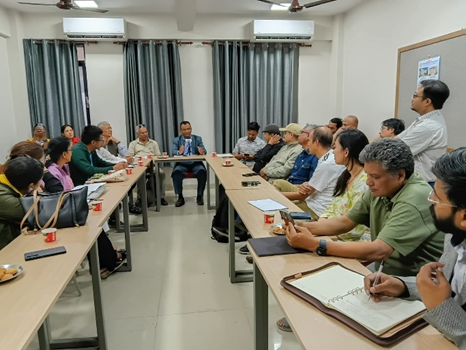
The session increased awareness of the historical significance of Mithila/Tirhut and strengthened interest in further research and documentation. It highlighted the importance of archaeological research, heritage mapping, museums and interpretation centers, community participation, institutional collaboration, and heritage-sensitive local planning.
To sum up, the session demonstrated the architectural and cultural heritage of Mithila/Tirhut as an important but underrepresented part of Nepal’s history. Continued research, documentation, conservation, and public engagement are essential to protect this heritage and ensure that it receives greater recognition in academic, cultural, and urban development discussions.