Urban Dabali : Urban Floods in Nepal – From Recurring Crisis to Resilient Cities (Session 7)

Uncategorized
The seventh session of the Urban Dabali series, titled “Urban Floods in Nepal – From Recurring Crisis to Resilient Cities,” was held on 30 July 2026 at Yen Dey Sanskritik Bhawan, New Road, Kathmandu. Jointly organized by the Centre for Integrated Urban Development (CIUD) and Helvetas Nepal, the session was a platform for government professionals, researchers, students, urban practitioners, and other stakeholders to discuss the root causes of urban flooding and practical approaches for developing flood-resilient cities. The key presenter of the session was Mr. Padma Sunder Joshi while the panelists included Mr. Machakaji Maharjan, Mr. Pawan Bhattrai and Mr. Yek Raj Adhikari. The session began with opening remarks from Mrs. Rija Joshi, Executive Director of CIUD, who emphasized the need to address the underlying causes of recurring floods rather than focusing…
Read More

Urban Dabali : Confronting Heat Waves and the Urban Heat Island Effect in Cities of Nepal (Session 6)

Uncategorized
The Urban Dabali session on “Confronting Heat Waves and the Urban Heat Island Effect in Cities of Nepal” was held on 30 June 2026 at the CIUD Office Hall, Gusingal, jointly organized by the Centre for Integrated Urban Development (CIUD) and Helvetas Nepal. The session brought together researchers, government representatives, professionals, students, urban practitioners, development organizations, and interested participants to discuss the growing challenge of extreme heat in Nepal. It focused on increasing awareness, sharing knowledge on heat monitoring and forecasting, discussing existing policies and response mechanisms, and identifying practical approaches to strengthen heat resilience. Mr. Anuj Tiwari introduced the RAIN Project, which is structured around four major components: Early Warning and Early Action, Community Resilience and Adaptation, Inclusion and Localization, and Shock Responsive Social Protection. He highlighted the increasing…
Read More

Urban Dabali : Medieval Urbanism and Architectural Heritage of Mithila/ Tirhut(Session 5)

Uncategorized
The fifth session of the Urban Dabali series titled “Medieval Urbanism and Architectural Heritage of Mithila/Tirhut”was held on 29 May 2026 at Universal Engineering and Science College, Chakupat, Lalitpur. Jointly organized by the Centre for Integrated Urban Development (CIUD) and Helvetas Nepal, the session focused on the historical, architectural, and cultural significance of the Mithila/Tirhut region and the need for greater recognition and conservation of its heritage. The program began with opening remarks by Ms. Rija Joshi, Executive Director of CIUD, who emphasized the importance of understanding and preserving Nepal’s diverse cultural heritage. Mr. Sudarshan Rajbhandari, Program Director of CIUD, introduced the Urban Dabali platform and explained its role in creating dialogue on urban development, heritage, planning, and related issues. The participants of the session included researchers, heritage professionals, students, urban…
Read More

Urban Dabali : Sustainable Urban Mobility for Livable Cities(Session 4)

Uncategorized
The fourth session of the Urban Dabali series, titled “Sustainable Urban Mobility for Livable Cities,” was held on 30 April 2026 at Sajha Southasia Centre, Pulchowk, Lalitpur. The session brought together policymakers, experts, practitioners, academics, and other stakeholders to discuss urban planning, mobility, public transport, and urban safety, with a focus on creating inclusive, sustainable, and people-centered cities. The program was hosted by Mr. Sudarshan Rajbhandari, with opening remarks from Mr. Niraj Acharya of Helvetas Nepal. The key presenter Mr. Sagar Onta, Transportation Expert, delivered the keynote presentation, followed by a panel discussion moderated by Ms. Rija Joshi, Executive Director of CIUD. The panel included Prof. Dr. Sangeeta Singh, Mr. Ashish Gajurel, Mr. Bhushan Tuladhar, and Ms. Nilima Thapa Shrestha. The discussion highlighted major challenges in Kathmandu Valley, including limited…
Read More

Urban Dabali | Addressing Groundwater Issues of Terai Plains of Nepal(Session 3)

Uncategorized
The third session of CIUD’s Urban Dabali series, titled “Addressing Groundwater Issues of Terai Plains of Nepal,” was held on 30 March 2026 at Universal Engineering and Science College, Lalitpur. The third session focused on the increasing challenges surrounding groundwater availability, quality, and management in Nepal’s Terai region. The session was organized in connection with World Water Day and was aimed to raise awareness about groundwater depletion, share technical and field-based knowledge along with the promotion of integrated, climate-resilient groundwater management. The program began with remarks from Rija Joshi, Executive Director of CIUD, who emphasized the importance of collaborative and actionable dialogue among local governments and stakeholders. Badri Manandhar from Helvetas Nepal highlighted the dual challenges of declining groundwater levels and deteriorating water quality resulting from over-extraction, urbanization, and agricultural…
Read More
URBAN DABALI: Indigenous plants and culture for livable cities in Nepal(Session 2)

URBAN DABALI: Indigenous plants and culture for livable cities in Nepal(Session 2)

Uncategorized
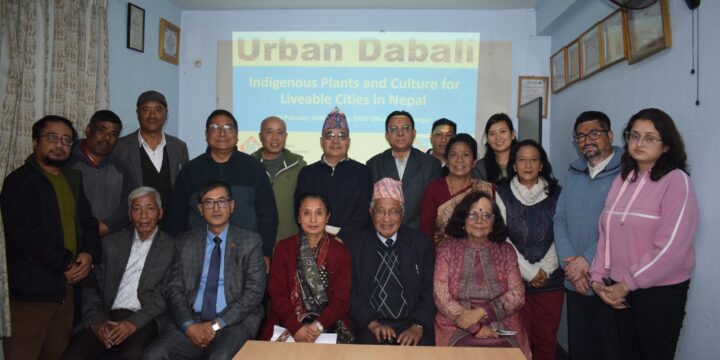
The second episode of Urban Dabali, was held on February 23, 2026 on “Indigenous Plants and Culture in Nepal for Liveable Cities in Nepal”. The Urban Dabali program is being organised by the Centre for Integrated Urban Development (CIUD) to promote dialogue in urban issues. The program was focused on Raising awareness about the importance of indigenous plants in urban environments, share municipal experiences, academic research, and community initiatives, discuss policy gaps and technical guidelines for urban greening and encourage citizen engagement, school participation and public-private collaboration. The main presentation was delivered by Dr. Nirmala Joshi Pradhan, highlighting on the indigenous plants and endemic plants of Nepal and its linkages with culture, heritage and identity of nation. Importance of indigenous plants in ecology, food security and bio-diversity maintenance. Experts including…
Read More

Urban Dabali : Plastic Circular Economy for Sustainable Cities (Session 1)

Uncategorized
The Urban Dabali Program on Plastic Circular Economy (PCE) was organized by the Center for Urban and Infrastructure Development (CIUD) on 30 January 2026 at the CIUD Office Hall, Gusingal. The program aimed to create a platform for knowledge sharing and collaboration on sustainable plastic waste management in urban areas. Yash Man Karmacharya, Program Manager at CIUD, welcomed the participants, while Rija Joshi, Executive Director of CIUD, highlighted the importance of continuing the Urban Dabali platform as a regular forum for discussing innovative urban solutions. She noted that CIUD planned to organize the program monthly from 2026, with a focus on sharing experiences, addressing public perceptions, and exploring opportunities for collaboration. The presentation also emphasized the importance of source segregation, efficient collection systems, community participation, and behavioral change. The presenter…
Read More

Traditional Pond Conservation Workshop

Uncategorized
In collaboration with Lalitpur Metropolitan City and Lagankhel Batabaran Sudhar Sanstha, CIUD organized a knowledge sharing workshop titled ‘Traditional Pond Conservation’ on June 2, 2023. The objective of the workshop was to share the key findings of various studies conducted by researchers and experts on various dynamics of the traditional ponds including their socio-cultural, ecological and technical aspects. Three experts presented their research works depicting the religious, cultural hydrogeological significance of the ponds. One of the researchers engineer Padma Sundar Joshi, Chairperson, CIUD, shared his findings on feasibility study of reviving the Tikabhaitav Rajkulo, a traditional irrigation canal that was built specially to feed the ponds in the upper region of the Patan city for the purpose of groundwater recharging. A representative from Bhaktapur also shared his experience of pond…
Read More
Why Asset Management is important to solve water systems’ problems in the development context

Why Asset Management is important to solve water systems’ problems in the development context

Uncategorized
Does world-wide water infrastructure coverage fulfil the Sustainable Development Goal (SDG) 6: “Ensure access to water and sanitation to all”? It would be great to answer this question with a confident ‘yes’ and considering the institutional efforts made and the increase in the number of water systems, we should be celebrating our progress towards this SDG. However, it is not that simple. When a water system is built, ongoing efforts are required to keep water flowing. For example, the latest reports (2014) from Nepal show that only 50% of the water systems in country are functioning well [1]. This implies that most people in rural areas still do not have access to this vital liquid, or face serious constraints. For example, receiving water only for a limited number of hours per…
Read More