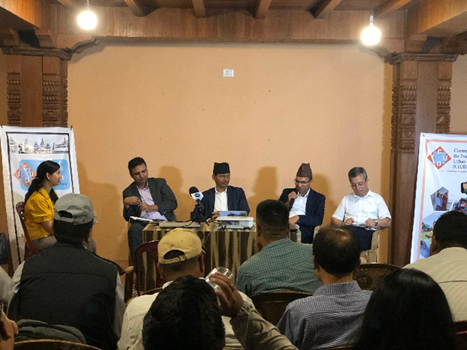
The seventh session of the Urban Dabali series, titled “Urban Floods in Nepal – From Recurring Crisis to Resilient Cities,” was held on 30 July 2026 at Yen Dey Sanskritik Bhawan, New Road, Kathmandu. Jointly organized by the Centre for Integrated Urban Development (CIUD) and Helvetas Nepal, the session was a platform for government professionals, researchers, students, urban practitioners, and other stakeholders to discuss the root causes of urban flooding and practical approaches for developing flood-resilient cities. The key presenter of the session was Mr. Padma Sunder Joshi while the panelists included Mr. Machakaji Maharjan, Mr. Pawan Bhattrai and Mr. Yek Raj Adhikari.
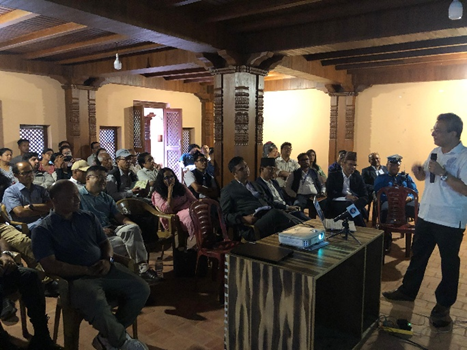
The session began with opening remarks from Mrs. Rija Joshi, Executive Director of CIUD, who emphasized the need to address the underlying causes of recurring floods rather than focusing only on emergency responses. The main presentation was given by Mr. Padma Sunder Joshi who highlighted the importance of allowing rivers to follow their natural courses. Using examples from the Rhine River and Kathmandu Valley, he explained how river straightening, encroachment, narrowing of river corridors, and excessive construction along riverbanks can increase flood risks. Furthermore, the cases of Nakkhu and Galchhi demonstrated how changes in river systems and surrounding land use contributed to the severity of the 2024 flood. He stressed the need to investigate past decisions, correct existing mistakes, and introduce preventive measures at both local and higher levels of government.
The panel discussion focused on river management, drainage, engineering practices, and policy implementation. Mr. Maharjan highlighted sewage overflow, waste accumulation, and river management challenges along the 80 km stretch of the Bagmati River. Mr. Pawan distinguished between fluvial and pluvial floods and emphasized that both require appropriate but coordinated management. He identified river encroachment, unmanaged mine materials, inadequate drainage, and increasingly intense rainfall linked to climate change as major concerns. He advocated retaining, detaining, and gradually releasing excess rainwater rather than relying only on larger drainage pipes. Proposed measures included groundwater recharge, rainwater harvesting, bio-soil infiltration, underground storage tanks, and better drainage planning.
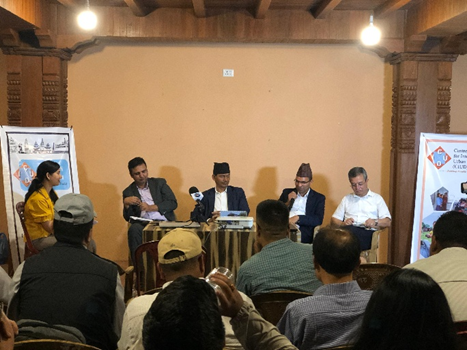
The discussion also emphasized the importance of integrated land-use planning and institutional coordination. Mr. Adhikari highlighted the need to integrate settlement density, waste management, runoff, infrastructure, and ecological considerations into long-term plans. Participants expressed their views about the weak coordination between government agencies and gaps between policy formulation and implementation as major challenges. The open floor discussion considered community awareness as an essential part, as poorly informed community initiatives can negatively affect mobility, biodiversity, and natural systems. The participants also raised concerns about rainwater harvesting, groundwater depletion, lack of open spaces, riverbank construction, and preparedness following the 2024 flood. They recommended incorporating rainwater harvesting into building bye-laws, promoting groundwater management, strengthening institutional coordination, and integrating ecological considerations into urban policies.
The session concluded with commitments and recommendations including reducing restrictive river walls, continuing Bagmati River clean-up efforts, promoting municipal-level rainwater harvesting, developing underground water-storage systems, standardizing drainage, protecting river corridors, identifying or acquiring vacant and encroached land, and establishing a strong coordinating mechanism among planning and implementing institutions. Overall, the session reinforced the need for river-sensitive, integrated, climate-resilient, and people-centered urban planning to reduce future flood risks in Nepal.