
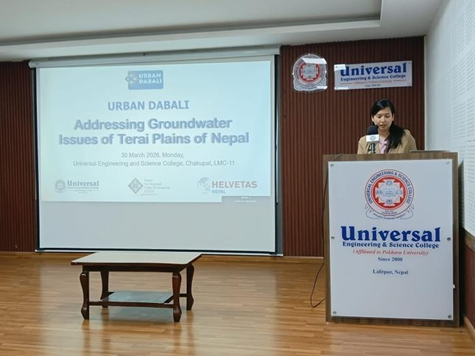
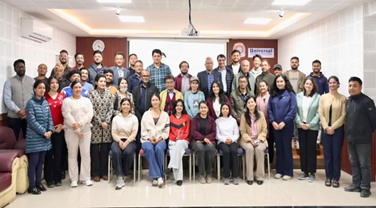
The third session of CIUD’s Urban Dabali series, titled “Addressing Groundwater Issues of Terai Plains of Nepal,” was held on 30 March 2026 at Universal Engineering and Science College, Lalitpur. The third session focused on the increasing challenges surrounding groundwater availability, quality, and management in Nepal’s Terai region. The session was organized in connection with World Water Day and was aimed to raise awareness about groundwater depletion, share technical and field-based knowledge along with the promotion of integrated, climate-resilient groundwater management.
The program began with remarks from Rija Joshi, Executive Director of CIUD, who emphasized the importance of collaborative and actionable dialogue among local governments and stakeholders. Badri Manandhar from Helvetas Nepal highlighted the dual challenges of declining groundwater levels and deteriorating water quality resulting from over-extraction, urbanization, and agricultural demand. He stressed the need to protect recharge areas and strengthen monitoring and governance systems.
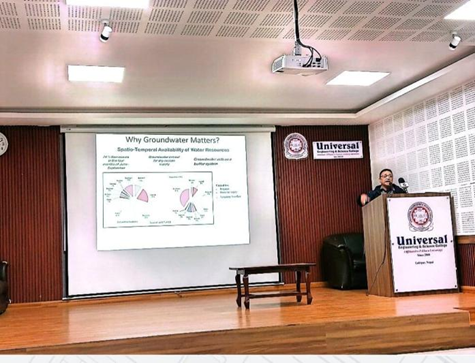
The main technical presentation was presented by Er. Surendra Raj Shrestha, who explained the hydrogeological characteristics of the Terai where groundwater is a major source for irrigation, domestic use, and ecosystem sustainability, particularly during dry seasons. The Terai consists of a complex, multi-layered aquifer system, including shallow aquifers at approximately 10–30 m while deeper confined aquifers extending up to 250 m. He also identified the Bhabar zone as an important recharge area because of its high infiltration capacity.
The presentation highlighted emerging groundwater stress, particularly in Madhesh Province, where declining groundwater levels and drying hand pumps were observed. Main causes for this include climate variability, increasing agricultural and domestic extraction, inefficient water infrastructure, and gap in governance. However, it was also clarified that tube-well failure does not necessarily mean groundwater depletion. Possible failure could include poor design, improper screen placement, inadequate gravel packing, pump–aquifer mismatch, and insufficient maintenance. Groundwater quality was another major concern, especially arsenic contamination,along with iron, manganese, and lead, emphasizing the need for regular and depth-specific water quality monitoring.
The proposed solutions included Managed Aquifer Recharge (MAR) through recharge ponds, infiltration trenches, and injection systems; protection of natural recharge zones in the Bhabar and Chure areas, improved irrigation efficiency, stronger monitoring systems, and regulations for groundwater abstraction as well as well spacing. Furthermore, a phased management roadmap was also proposed which included system repair and monitoring in the short term, recharge and regulatory interventions in the medium term, and climate-resilient integrated groundwater management in the long term.
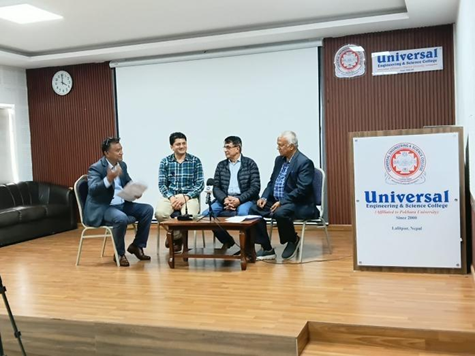
The panel discussion further emphasized that groundwater stress is linked to over-extraction, unplanned urbanization, agricultural demand, environmental degradation, and weak governance. The importance of protecting the Chure/Siwalik region as a recharge zone was strongly focused, as deforestation and degradation can negatively affect groundwater recharge. Panelists also suggested for scientific monitoring, data collection, groundwater modeling, evidence-based policies, and stronger institutional coordination.
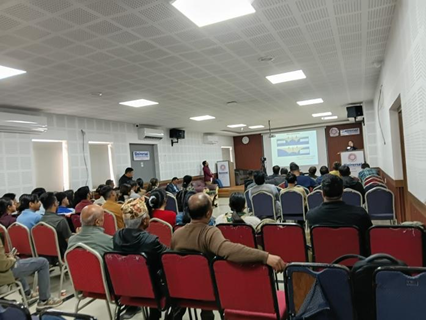
The open discussion highlighted seasonal water scarcity, tube-well performance, climate change, technical maintenance, and the need for local governance. Participants discussed examples from Japan and India involving retention ponds and infiltration systems and emphasized greater municipal involvement, community awareness, and potentially establishing local water management boards.
To encapsulate, the session concluded that groundwater stress in the Terai is emerging and expanding, particularly in Madhesh
Province. Sustainable management requires a combination of technical solutions, environmental conservation, effective governance, community participation, continuous monitoring, and evidence-based planning. Major recommendations from the session included developing a comprehensive groundwater policy, strengthening monitoring, protecting recharge zones, improving tube-well standards, coordinating drinking-water and irrigation sectors, and promoting climate-resilient water management.