
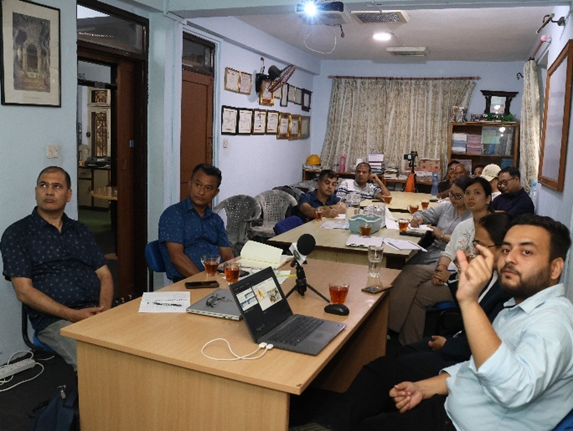
The Urban Dabali session on “Confronting Heat Waves and the Urban Heat Island Effect in Cities of Nepal” was held on 30 June 2026 at the CIUD Office Hall, Gusingal, jointly organized by the Centre for Integrated Urban Development (CIUD) and Helvetas Nepal. The session brought together researchers, government representatives, professionals, students, urban practitioners, development organizations, and interested participants to discuss the growing challenge of extreme heat in Nepal. It focused on increasing awareness, sharing knowledge on heat monitoring and forecasting, discussing existing policies and response mechanisms, and identifying practical approaches to strengthen heat resilience.
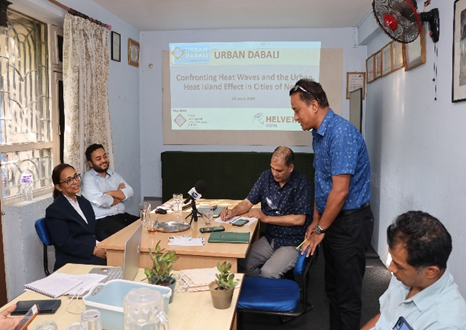
Mr. Anuj Tiwari introduced the RAIN Project, which is structured around four major components: Early Warning and Early Action, Community Resilience and Adaptation, Inclusion and Localization, and Shock Responsive Social Protection. He highlighted the increasing occurrence of unusually high maximum and minimum temperatures across major cities in Nepal and the resulting health risks, particularly for daily wage workers, drivers, street vendors, pedestrians, and others exposed to direct sunlight. The project has developed Early Action Protocols for Lumbini and Madhesh using 40–45 years of data from Department of Hydrology and Meteorology (DHM) and has implemented municipal-level interventions based on weather forecasts and local analysis. In Kabilashi Municipality, heat-risk information was communicated through social media, murals, and local languages, contributing to practical measures such as shifting the local Haat Bazaar from afternoon to morning.
The presentation also emphasized the fact that temperatures recorded by meteorological stations may not represent the actual heat experienced in different urban environments. Local factors such as shade, building materials, and work conditions can influence heat exposure. Therefore, pilot projects in schools and municipal offices are being conducted to generate more localized data. Other RAIN interventions include nature-based solutions, impact-based heat forecasting, health check-ups, awareness programs, mobile water services benefiting over 17,500 urban workers, and local-language heat-risk campaigns.
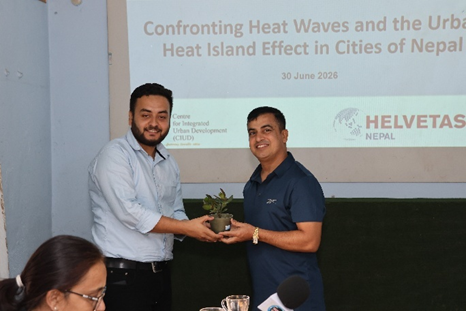
The panel discussion further highlighted changes in Nepal’s climatic conditions and the need for improved heat monitoring and localized data. Ms. Bibhuti Pokharel noted ongoing efforts by DHM to integrate data from different projects into future policies and planning. Dr. Yadav Prasad Joshi discussed the health impacts of extreme heat, particularly on children, older people, daily wage workers, and other vulnerable groups, while highlighting gaps in the implementation of existing policies and frameworks at the local level. He also emphasized the need for heat-resilient guidelines for public buildings such as schools and hospitals.
The open-floor discussion focused on strengthening Early Action Protocols through policy revisions, assessment and documentation of scientific evidence. Participants also raised concerns for economically poor communities who cannot afford cooling equipment. Strengthening collaboration among government institutions, experts, development organizations, and local communities was identified as essential for improving Nepal’s preparedness and resilience to increasing heat-related risks.